
Source: Franchise Times
Legacy fast-food chain A&W is taking steps to integrate its 107-year history into modernization efforts. The brand’s CEO sees the blend as a no-brainer: We really want to make sure we have that sense of history, but it’s got to feel of today.
It’s no easy feat to make 107 years old sound fresh, but it’s an endeavor Betsy Schmandt and her team are striving for at fast food chain A&W.
“We’re making sure we not only honor our heritage and our history,” said Schmandt, A&W’s CEO and president, “but bring it forward into the modern quick-service restaurant experience so that people really don’t have us in the rear view.”
This year, A&W celebrates a century of franchising in an ever-expansive and competitive QSR category.
Domestic franchise growth has been stagnant or on the decline in recent years; today, the brand sits around 850 global units, with half in the United States and the rest spread across several countries in Asia. (A&W Canada is a separate company and is publicly traded on the Toronto Stock Exchange. It’s led by CEO Susan Senecal and has more than 1,000 units.)
No one is more aware of A&W’s position than Schmandt, who stepped into the CEO role a little more than a year ago. Schmandt joined the company as president and chief operating officer in 2023, but she can trace her relationship with the brand back to her childhood growing up near a classic A&W drive-in in Ashland, Ohio.
“We went for hot dogs and the frosty mug, and they had the tray on the window. It was a really fond memory of mine when I used to go to this place with my parents,” Schmandt said. “When this opportunity came up … I absolutely loved the story, their journey and the opportunity to be part of this nostalgic brand that is ready for a resurgence. I really wanted to help rebuild that.”
A&W’s revitalization plans align with the brand’s new vision: seeing A&W as the heart of your hometown. Schmandt said she’s taking that mantra seriously when it comes to brand innovation and ensuring it resonates with consumers and franchisees alike.
“That ‘heart of your hometown’ is how we lead. It’s that feeling we want people to have when they walk into our restaurants—that they are truly welcome. We want them to have that hometown feel … along with our new motto of ‘quality that floats above the rest,’” she said. “I think when you’re driven by this emotional connection but also that quality piece, it’s a winning combination for how we’re going to drive the business forward.”
Leading innovation is A&W’s revamped store design, aptly named “modern heritage.”
The company hired a new agency at the end of 2025 and kicked off plans for store and asset designs just last month.
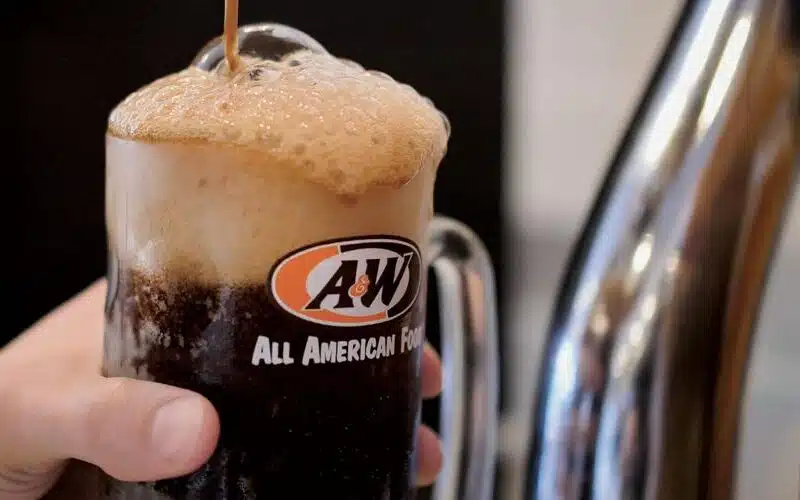
A&W’s many touchpoints—notably its signature root beer served in frosty mugs—are steeped into the brand’s legacy and look to be carried into modernization efforts.
But just how is the question A&W is working to answer early in the store redesign process.
“We really want to make sure we have that sense of history, but it’s got a feel of today. It won’t be a drive-in, but there may be visual elements that bring us that feeling of what a drive-in is. We want to make sure it has a contemporary feel but honors those traditions,” Schmandt said. “The frosty mugs, the made-fresh root beer—that root beer piece is going to be important. How do we visualize that and really highlight it more than we have been?”
Schmandt is targeting the middle of this year for having design work done, with a systemwide rollout beginning toward the end of the year.
Blending tech and nostalgia
Meredeth Jones, A&W’s vice president of franchise development and design, is leading store design efforts with her team. Integrating technology into new and existing units has worked in tandem with modernizing the brand. Case in point is the company’s modernized tech stack with a new point-of-sale system, inventory management and data analytics.
Technology has also given consumers the ability to order beyond traditional, over-the-counter methods with online, in-app ordering, third-party ordering and self-service kiosks. Just this last year, the company launched tableside ordering.
Jones refers to A&W’s revitalization blend as new nostalgia, or “newstalgia,” a theme she’s enjoyed utilizing a little more than a year with the company.
“We’re still saving a place for the people that want the human interaction … but I think it’s really huge for A&W to embrace the technology,” Jones said. “It’s modern heritage that says, ‘Hey, we’re still A&W, but we understand where people want to interact with us, and we’re going to meet them where they’re at.’”
Technology also taps into the franchisee side as the brand develops a refreshed franchise development website. Storytelling pulls the brand’s legacy into today’s development and lead generation initiatives, Jones said, highlighting the system’s second, third and fourth-generation franchisees.
Jones said the new website will include franchise testimonials and videos incorporating these stories. A&W’s lead generation strategies will lean heavily into digital this year, she added, connecting with prospective franchisees through platforms like Meta and YouTube.
Amid the upgrades, it’s been crucial to get the brand’s franchisees on board. Communication and clear-cut data have been the pieces to win them over.
With a legacy brand, “you’re always going to have some resistance,” Jones said. “But if you can continuously communicate and show the value to what you’re doing, I think it goes a long way and eases some of that trepidation existing franchisees have.”
“When we can show sales data, the increase in sales, the increase in check average with tableside ordering or kiosk or third-party delivery, it’s much easier to bring franchisees along,” she added.
Franchisee input is also driving innovation, especially on the menu side.
“It’s taken us a couple of years, but it was one of the things I heard time and time again: ‘We want a chicken sandwich. We need a chicken sandwich,’” Schmandt said.
Sure enough, A&W delved into chicken. The brand tested a hand-breaded chicken sandwich in the Green Bay, Wisconsin, market last fall to positive feedback, rolling it out across all its restaurants by spring.
“Chicken is a core menu item,” said Amanda Potts, vice president of marketing and innovation, “but this is going to allow us to innovate against chicken in a way we haven’t done before.”
A&W is making big moves with QSR trends, in the case of chicken and most recently, pickles, seen with the brand’s limited-time dill pickle ranch cheese curds.
But Potts, who joined the company in February 2025, also sees opportunity to lead in other trends.
“We absolutely think we have a right to play in the beverage space, just like our competitors. We’ll be doing a ton around beverage this year as we’re the original craft beverage. Not many other consumers can say that,” she said. “Our brand was built around root beer, so I think that’ll be what will differentiate us.”
On the marketing side, Potts is excited about the brand’s new partnership with media agency Novus Media—one she believes will benefit advertising at the local level. The company doubled its media investment for 2026 and recently revamped its marketing assets.
Potts and the marketing team are tackling social media trends by tying in the brand’s iconic offerings, branding and longtime mascot, Rooty, the Great Root Bear.
“In just about every post,” Potts said, “there’s a little nod to the past in some way.”
Schmandt expects to open between 10 and 12 units this year, with development broadly set in the Upper Midwest. Looking to the rest of 2026, she sees A&W’s position in QSR changing for the better and building upon its storied legacy.
“I think this will be a great step forward on how we best present ourselves in the market,” Schmandt said, “making sure people really see A&W as the special brand that it is—but current for today.”